


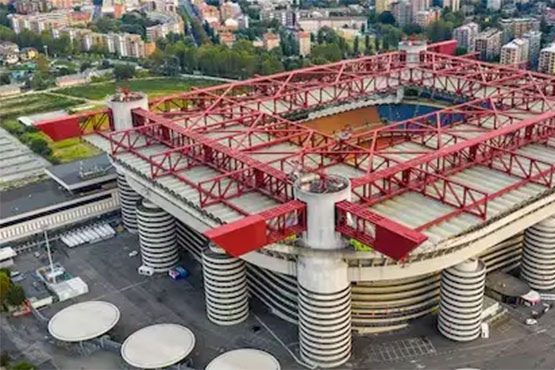
Milan’s San Siro, one of the world’s most famous stadiums, is about to become a thing of the past. The 99-year-old arena, home to the Inter and AC Milan football clubs and their fans for decades, is likely to be in the global spotlight for the last time. The stadium will host the opening ceremony of the Milan-Cortina Winter Olympics today.
Inter and AC Milan bought the San Siro and the surrounding area from the city council in November and have already planned to build a new, state-of-the-art stadium in its place. Demolition work is likely to begin soon.
It should be ready in time for the 2032 European Championship, which Italy will co-host with Turkey.
Why is San Siro so special?
The stadium was initially named after the San Siro district of Milan, in which it is located. However, in 1980, a few months after the death of the legendary Milanese footballer, the name was officially changed to “Giuseppe Meazza.”
Officially, it is called the Giuseppe Meazza Stadium in honor of the two-time world champion of Italy, the legendary footballer of “Inter” and “Milan.” However, many continue to call it simply “San Siro” or “La Scala of football,” comparing it to the famous Milan opera house.
The stadium was built in just 13 months (1925-1926) and initially accommodated 35 thousand spectators. Over the decades, it has been expanded several times, reaching almost 80-85 thousand. The last major reconstruction, carried out before the 1990 World Cup, gave it its recognizable appearance, with its famous round towers.
Not only football
San Siro was not only a home for football but also for concerts. Bob Marley, Michael Jackson, Madonna, the Rolling Stones, Bruce Springsteen, and Vasco Rossi have all performed here. Boxing matches, rugby matches, Italian national team matches, World Cup matches in 1934 and 1990, and European Championship matches in 1980 have all been held here.
Now, San Siro is preparing for its last big performance: the Olympic opening ceremony (where capacity will be reduced to 60,000). After that, the demolition process will begin, making way for a new generation of stadiums.